
Looks like you're visiting from {country}...
Switch to our {language} site for local pricing and products
Merchant insights
Credit card machine fees explained
Taking card payments is standard for almost every business today. But understanding what you actually pay for those transactions isn’t always as clear.
IN THIS ARTICLE
This is a div block with a Webflow interaction that will be triggered when the heading is in the view.
.avif)
Credit card machine fees can vary depending on the provider, the pricing model, and how your business operates. Some charge monthly fees. Some charge per transaction. Some combine both.
We’ll break down how card machine fees work, what you should expect in the UK, and what to look for when choosing a provider so you can make the right decision for your business.
Key takeaways:
- Card machine fees usually include transaction fees, monthly costs, and sometimes additional charges.
- Most UK providers use either a monthly subscription model or a flat transaction-based pricing model.
- Lower headline fees don’t always mean lower overall costs – extra charges and contracts can add up.
- Buying a card machine often gives more flexibility, while rental models can come with ongoing fees and commitments.
- For most small businesses, the best option is one that gives you clear costs, no hidden fees, and works reliably day to day.
What are card machine fees?
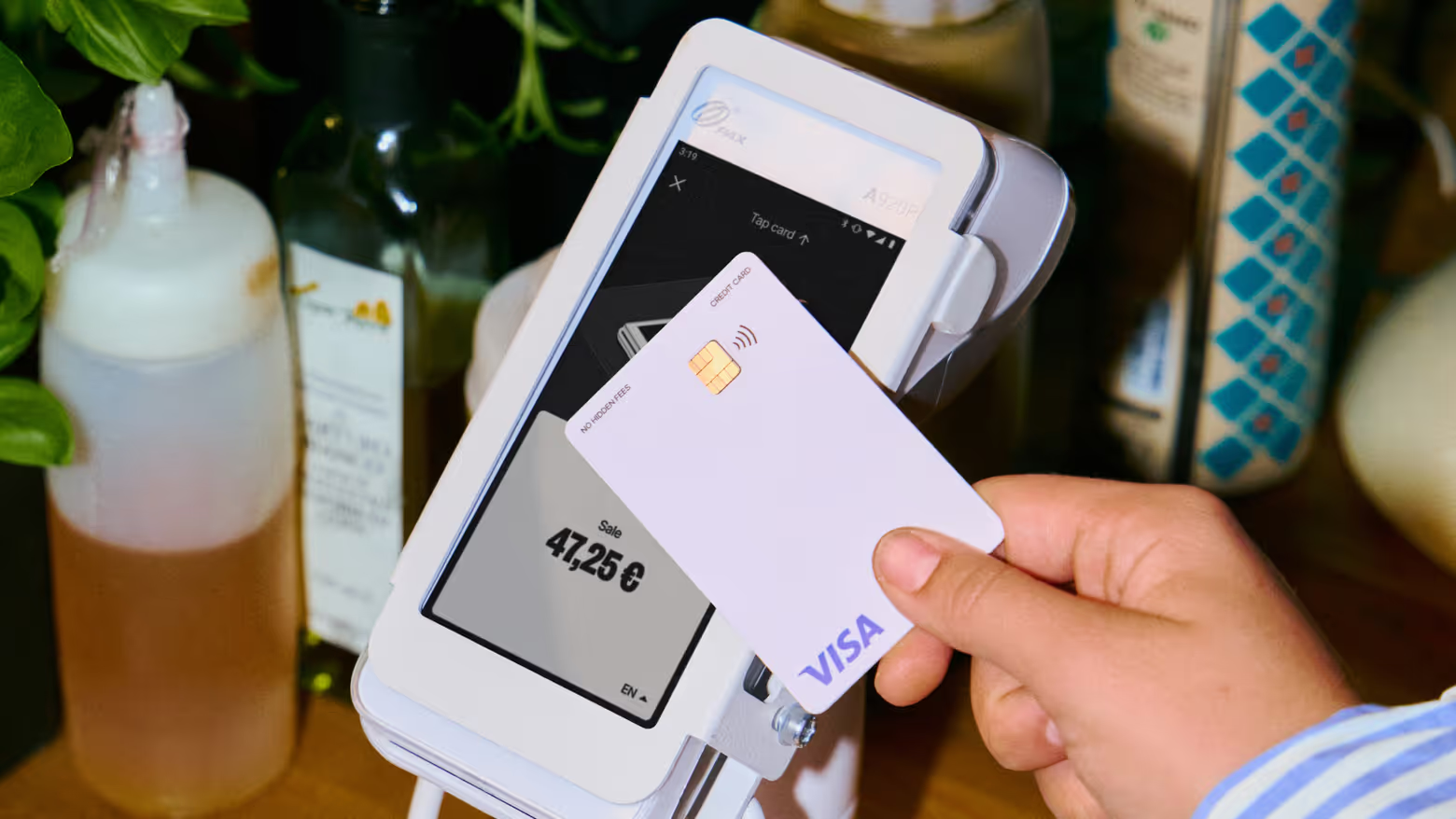
Card machine fees are the costs you pay every time a customer pays by card. They usually come in a few different forms:
- Transaction fees – a percentage (or fixed amount) taken per sale
- Monthly fees – a fixed cost for using the system
- Hardware costs – payment for the card machine itself
- Additional charges – e.g. contract fees or service add-ons
When people talk about credit card machine fees, they’re usually referring to the total cost of accepting card payments – not just one single charge.
How card machine fees work
In simple terms, every card payment follows the same process:
- A customer pays by card
The customer taps or inserts their card, or uses their phone to pay. - The payment is processed
The transaction is sent through the payment provider and the banking network for approval. - Fees are applied
The provider takes their fee – usually a small percentage of the transaction. - You receive the remaining amount
The rest of the money from the payment is transferred to your account.
These card machine transaction fees are taken automatically, so you don’t need to calculate anything manually.
How much are credit card machine fees in the UK?
In the UK, you’ll typically encounter one of these pricing models:
- Percentage-based fees (common for card readers and POS systems)
- Monthly subscription + lower transaction fees
- Flat-rate pricing models
On average, credit card machine fees UK businesses pay depend heavily on volume and provider structure.
For low-volume businesses, simplicity often matters more than small percentage differences. For high-volume businesses, small fee differences can add up quickly.
Card machine fees – purchase vs rental
When comparing providers, you’ll usually come across two main options: buying a card machine or renting a card machine. Both come with different costs – and different trade-offs.
Buying a card machine
With this model, you pay upfront for the device and then use it with a payment provider.
What to expect:
- One-time cost for the card reader
- No monthly rental fees
- Fixed transaction fee per payment
- No long-term contract in most cases
This is often a simple, flexible option – especially for small businesses that want predictable costs.
Renting a card machine
With rental, you don’t buy the device. Instead, you pay a monthly fee to use it.
What to expect:
- Lower or no upfront cost
- Monthly rental fees
- Often tied to a contract (e.g. 6–18 months)
- More complex pricing structures
Rental can work for some businesses, but costs can add up over time – especially if multiple fees are involved.
Comparison: typical card machine fees in the UK
Here’s a simplified comparison of how card machine costs are usually structured:
What does this mean in practice?
On paper, rental models can look cheaper – especially if the transaction rate is lower.
But in reality, you’re often paying for:
- Monthly subscriptions
- Additional service fees
- Long-term contracts
- Extra charges for things like reporting or compliance
That can make it harder to predict your total costs.
Card machine purchase vs rental – which option is better for a small business?
For most small and medium-sized businesses, the priorities are simple:
- Clear pricing
- No long-term commitment
- Costs that are easy to understand
That’s why many choose a purchase-style or no-monthly-fee model. It keeps things flexible and avoids unnecessary overhead.
Some providers, like Flatpay, take this a step further by removing upfront costs as well. With no monthly fees, no upfront cost for the card terminal, and a flat 1.49% transaction rate, it’s easier to predict what you’ll pay – without needing to factor in extra charges or contracts.
Your questions answered
Is there a card machine with no fees?
No card machine is completely free to use. Even if there is no monthly fee, there will always be a transaction fee when a customer pays by card. That’s how payment processing networks operate.
Which card reader has no monthly fee?
Some providers offer card readers with no monthly subscription. Instead, they charge a fee per transaction. This is often the best option for small businesses that prefer flexible, usage-based costs.
Flatpay, for example, has a 0£ monthly fee and keeps pricing simple with a 1.49% flat transaction rate – so you only pay when you take a payment.
Which card machine has the lowest fees?
There is no single ‘lowest fee’ card machine for everyone. It depends on how your business operates.
- Low transaction fees may suit high-volume businesses
- Simple flat pricing may suit smaller businesses
- Hidden fees can make ‘cheap’ providers more expensive overall
The key is understanding total cost – not just the advertised rate.
What is the cheapest credit card machine to use?
The cheapest option depends on your sales volume and how fees are structured. Some businesses save money with low monthly subscriptions, while others benefit more from transparent, per-transaction pricing.
What matters most is predictability. A system with no hidden fees is often easier to manage and plan around.
Is there a free card reader?
Yes – some providers, like Flatpay, offer a card reader at no upfront cost.
What’s important to understand is that even if the hardware is free, there will still be a fee when you take a payment. That’s how card processing works.
With Flatpay, the pricing stays simple:
- No monthly fees
- No hidden charges
- Just a flat transaction rate when you get paid
So while the card reader itself can be free, your costs remain clear and predictable.
What to look for in a card machine provider
When choosing a card machine, the important thing is not just cost, but clarity.
Look for:
- Transparent pricing with no hidden fees
- Simple, predictable transaction costs
- No long or complex contracts
- Reliable support when you need it
- A system that fits your day-to-day operations
In short, a good provider should make payments simple to understand.
Take control of your payment costs
Card machine fees can look complicated at first, but they all come down to the same thing: how much you pay to accept card payments.
The challenge is that pricing structures vary widely, which makes comparison difficult. The simplest approach is to focus on total cost, clarity, and consistency rather than just headline rates.
For many small and medium-sized businesses, predictable pricing with no hidden fees can make day-to-day operations easier to manage and plan.
Flatpay offers simple, transparent pricing with no monthly fees and no hidden charges, so you always know what you’re paying when you take a payment.

Accepting payments for any business, anytime, anywhere
Two solutions designed to get you paid.


Getting paid starts here
Let us get you set up to accept card payments and manage orders in one place. Get started today and see how smooth running your business can be with Flatpay.

